Tuesday, December 3, 2013

Cusco: Navel of the World


Incans, deeply in touch with the natural world known as Pachamama, a people of the sun.
            The streets were cold and nearly deserted at 7am as I wandered through old town, doing my best to politely refuse the hawkers who, even at this ungodly hour, swarmed me with offers of massages, tours, and hot meals. The old women on the street corners peeled potatos in their cheerfully colorful traditional garb. Their weathered hands preparing food for the Peruvians that would head to work that morning in the bustling tourist hub of Cusco
              Cusco, meaning "Navel of the World" in the local dialect of Quechua, is the former capital of the Incan empire. It stretched throughout Peru, Ecuador, Bolivia, Colombia, and northern Argentina at its height. The splendor of Cusco was renowned when the Spaniards invaded at the first half of the 16th century. They looted the temples. They oppressed the people's culture. They stole the gold and silver. They smashed the idols. They tore down the sacred places to build cathedrals. Yet somehow, the spirit of the Incan people survived to merge with that of their conquerors and made a beautiful mix that persists today. With the idea of a Machu Picchu trek in the back of my mind, I was joined by my new friend from Lima, Tracie, as we explored the city. 
            Cusco is a wonderfully busy hub for tours to Machu Picchu and other ancient ruins in the area, leaving it a home to music and art that thrives on the idea of embracing their ancient roots. I managed to get into a concert by two students who had spent the last year and a half traveling small Andean villages to collect and record some of the most traditional songs. This style, Huayno, has survived over 500 years. Its still incredibly popular, and its not uncommon to hear its distinctive tones blasting from passing car stereos. I also had the good luck to stumble upon the local San Pedro market, off the beaten tourist path this hive of activity provides insight to the average life of most Peruvians in the region. With mountains of fruits, sacks of coca leaves, cheap food and goods, and even some more exotic local food (alpaca fetus and 10 year old potatoes among them). One could explore the intricacies of Cusco for months, if not a lifetime, and still find delightful surprises around every corner. My few days before my trek was not nearly enough to scratch the surface, but who knows, I might end up here longer than I planned in the end! For now, off to Machu Picchu!
A typical native rattle made from alpaca and llama claws, passed around during a demonstration by a traditional Cusquenian lutier.
Beautiful art on a crumbling wall overlooking the city of Cusco

Me and a grazing llama ovelooking Cusco.

The winding, narrow streets leading back toward the center of town.

The ancient streets of Cusco.

The sacred valley of Cusco, featuring the main square, the Plaza de Armas, below.
A woman in traditional Andean dress with an alpaca in front of an ancient Spanish monastery that incorporated the parts of Incan structures that the Spaniards couldn't tear down.
The doors are a brilliant blue, with fanciful knockers and handles, all adding a cheery feel to the chilly windswept streets.

Unfortunately, a Starbucks, a McDonalds, and a KFC ("Kentucky" as the locals call it) all adorn the main square. Here you can see a tour streaming past a shipment of frozen french fries for KFC waiting on the sidewalk.

The Peruvian and Incan flags flying proudly in Cusco's main square.

The main square at night after leaving a concert in the bohemian San Blas district

Light striking a dazzling array of fresh fruit displayed in the San Pedro market where I stocked up for my upcoming trek to Machu Picchu.

All the spices you could possibly imagine.

Monday, December 2, 2013

A Bus to Cusco: 22 Hours of Rollercoaster

       I had finally splurged and purchased the ticket with a bed. Ya know, it is a 22 hour bus ride, and I figured I could get some sleep on the way... no chance my friend! Thats because the bus to Cusco from Lima winds its way through the jagged Andes mountains. It is basically the windiest and least direct route ever. Don't believe me? A flight to Cusco is one hour from Lima. That means that in normal terrain the drive would be about 4-5 hours, but those clever Peruvians found a way to extend that reasonable journey to its present 22 hour state.
        To qualify my complaints, Peruvian busses are awesome. You get lunch, dinner, and breakfast. You get electricity and wifi (is no place sacred anymore?). You even have an optional (if very very limited) onboard library. Did I mention my seat reclines nearly horizontal, making it almost like a bed? They beat American busses by about 100000000%. That is not even hyperbole. Look it up. Pure science. But come on Peru, 22 hours? Blast those sacred mountains back into their place with a liberal dose of dynamite! 
        On arrival on Cusco, I crawled into a coma and slept for hours in order to fight off the sleepless night and the creeping altitude sickness that was trying to give me a hearty embrace at 3,400 meters. After waking, I grabbed a Pisco Sour (I mean, seriously, what else would you drink?) and set off in search of the best way to get to the famous Machu Picchu!

Sunrise over a foggy mountain valley where the campesinos were already out in the fields working.
Tearing through the desert coast of Peru on the way to Cusco.... this desert can make the moon look extremely fertile at times!
I awoke (kinda, I you dont every REALLY fall asleep on this bus ride...) to the foggy, twisting, mountain roads.


Tuesday, November 26, 2013

Movie Premier: Cotopaxi Volcano Climbing!

Cotopaxi and Chimborazu Volcanos on the way to the Quilotoa volcanic lagoon

Hey guys, I finally posted my first video from my travels!  Its about my time climbing volcanos in the central Andean highlands of Ecuador. This is from early September and it all happened with my awesome group of friends: Yaron Ohayon, Pauline M Stobbs, Jasmine Heinen and Tom Goldman! They were an amazing group, and this little video is dedicated to them 100%.
       The journey is great, but its truly the friends you make along the way that make it incredible!

Here is the link: https://www.youtube.com/watch?v=47r4sfA4Ra8

The video features video and pictures taken by me on our journey, along with music from Kylian (an underground Brooklyn artist who is featured on my "friends of this blog" list to your left...), Aloe Blacc, and some traditional Andean tunes. Take a look if you get a chance, sorry about the mediocre quality of the upload... my Cusquenian hostel doesnt have the greatest wifi connection haha.

From left to right: Jasmine, Pauline, Yaron. and Tom... A better group couldn't be found!

Sunday, November 24, 2013

Lima: Street Art Hunting In No-Gringo Zones

    
           So my day started with an early morning protest going on across the street, with the long line of protesters being ushered along by Riot Police. After a cup of coffee, I went for a walk, where I encountered a political rally in San Martin Plaza. This vibrant city definitely has a loud and vibrant voice. This manifests itself in the beautiful architecture, the political protests, the striking colors of the buildings, and the amazing abundance of street art that catches the eye at every turn.
                 With these thoughts firmly in my head, I decided to go on a hunt for some of Lima's best street art in its historic center. As one might imagine, the best street art is often in the worst neighborhoods of any city. Generally the places where the people have a hard time accessing traditional means of a public voice, tend to foster the rise of street art as a way communicate their messages.                         Although I'm sure I didn't even touch a fraction of the incredible art to be found in Lima, my hunt was fun and thrilling (It literally felt like a hunt as I stalked the places, then popped out my camera for a quick shot. All the while knowing that it could get me robbed or killed in some of the areas I went to... Lots of adrenaline in this one haha). Well, please enjoy my catch of the day and leave dozens of comments!

A beautiful bulding in one of Lima's less gringo friendly neighborhoods... 
The political rally in San Martin Plaza, featuring big heads!
Plaza 2nd of May, the heart of Lima's vibrant music district, famous for beautiful blue buildings housing dozens of music stores and schools. Also not a gringo safe area.
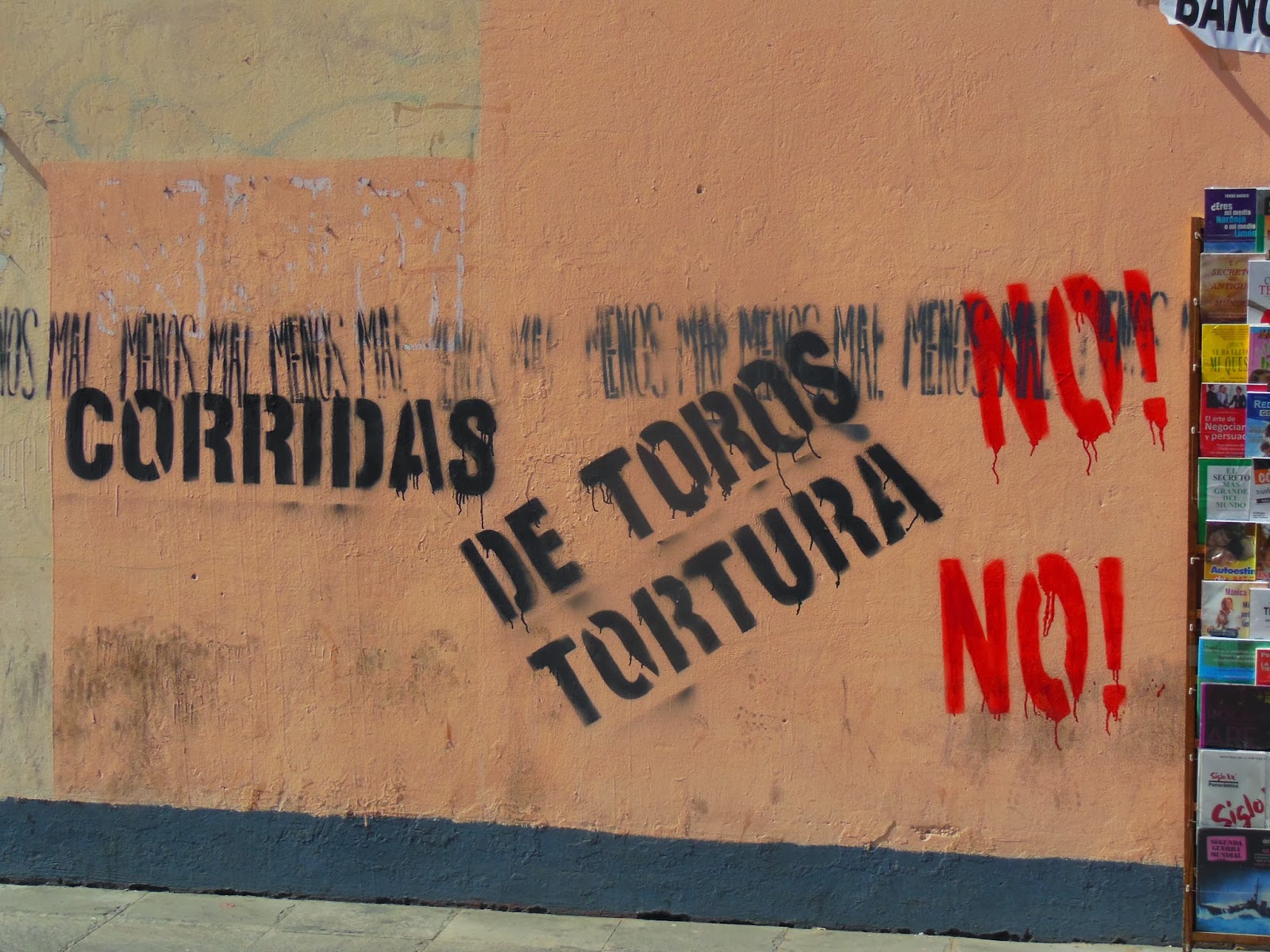
Protests against the bullfight season that is taking place at this time.


Saturday, November 23, 2013

Lima: Throwin Down In China Town


        I strolled through the characteristically chaotic streets, aiming to go nowhere in particular. Most people would probably see my slightly fast gait as a sign that I am in a hurry. In fact, its just a simple trick to avoid pick-pockets. It is far easier to notice someone who picks up speed to walk alongside you, allowing you to avoid being an easy target. No. I was really just enjoying a leisurely stroll on a fine sunny day, though one of Lima's busiest and most vibrant districts. Chinatown.
        
       During the middle to late 1800's, Chinese immigrants steamed towards the American coastline in search of abundant jobs as well as to escape the dangerous times at home. The Opium Wars and the Taiping Rebellion (a massive war involving millions of soldiers and a man claiming to be Jesus reborn) meant that hope for the future of millions lay on the shores to the east. The opportunities vanished in the U.S. with the Chinese Exclusion act in 1882, sending all those in transit to other ports along the American coastlines... One such port was Lima, where you can now find large Chinese communities, and their incredible food here as a result.
        This area, just a few blocks off the tourist rich areas of the Plaza De Armas, is one of the busiest sections of the city I have seen. I was warned against the pickpockets here by Eduardo, my Peruvian former room mate, but I faired well this day. All I had was my camera, which I used sparingly and kept firmly in my grip. The markets were an incredible display of variety, and had all the craziness you would expect of this Latin-Asian fusion neighborhood. 
       After my jaunt, I strolled through the better known financial district of old Lima in search of another legend. The Pisco Sour. This drink is made with the national liquor of Peru, Pisco, a mix of brandy and whiskey to my discerning tongue. The original bar that thought this national symbol up no longer exists, but the original recipe went to two others which still stand. My stop was the class Hotel Maury bar, where a finely dressed barman served me my drink in the cool, wood covered lounge. It was good. Even better, it was historic! After I finished, I thanked the barman and explained my quest. He pointed me to the Hotel Gran Bolivar in Plaza San Martin, where the other recipe ended up. I saved that one till later that night, but both of them were excellent of course. 
         I was feeling pretty good about my return to Lima, and I couldn't wait to really explore the city over the next few days!
          
My world famous Pisco Sour at the bar at the Maury Hotel
The fountains in the Plaza de Armas of Lima
Burning incense at a stall in Chinatown

Angels over the Cathedral of Lima in the Plaza de Armas
A silent guardian overlooking the China town markets
Peruvian Presidential guards 
The gateway to Chinatown

The beautiful colors you peek in doorways as you pass by...

Welcome to Chinatown!
Purple corn in a huge market in central Lima
Dried chili surrounded by sacks of all kinds of spices and herbs, all for sale fresh in the local market.


Monday, November 18, 2013

Mancora, Peru: Son of a Beach!


     I had finally made it to the world famous surfer's paradise, and endless party town of Mancora, Peru. Crowning the desolate north coast, this once sleepy fishing town has been swarmed in recent years by backpackers searching for the legendary waves and parties that never quit. I had booked into the party hostel, Loki, more to experience it than to partake. I'm not a big drinker, and generally prefer more relaxed atmospheres. The hostel certainly lived up to its reputation while I was there, with wild parties every night and the common areas draped by hungover backpackers every day. 
           I spent my time hanging out with an Argentinian psychology student, Exay. We walked the beach a bit, grabbed some of the 10 sole menus, and spent most of our time body surfing. The second day, we rented surfboards just to try it out. Being new to the sport, we were happy when the company let us know that the small waves were "perfect" for beginners. It was indeed perfect. Perfectly calm, with absolutely no waves. After an hour paddling out where the waves are normally abundant, and seeing we were the only ones out there, we decided to throw in the towel and accept that we had been swindled this time. 
         We paddled back into shore, but as we got close, we caught one or two baby waves. Exay was hesitant about this, not wanting to break his board in the shallows. I was frustrated by our lack of waves earlier, so I jumped on this opportunity to practice. Soon I was catching the small waves and riding them into shore with little problems, much to my delight. I saw a swell. I started paddling, and felt the rush as it caught me. I popped up and caught me balance, well on top of the wave. I'm up. I'm up. I'm down, as the wave dropped like a hammer into the beach. I was thrown from my board and heard a sickening "crunch." Knowing it wasn't me, I looked at my board. It was still attached to me, but about a third of the way down, the nose had snapped like a twig. Oh well. Thats the day for me. 
       Exay and I speculated about the costs of such damage before he kindly walked up the beach to translate for me at the shop.  We walked past all of the tourists and locals on the beach. We walked past all the bars to the shop at the entrance to our hostel. After consulting with the shop I had the honor of walking through the entire hostel full of surfers. Then across the main road full of locals and into the surf shop. It was probably one of the most humiliating walks of my life, accompanied by snickers and outright catcalls. Thankfully, an Aussie called out to remind everyone that it happens to us all. Gotta love Aussies.  The damage was less than expected, only about $40 in total thankfully.
      That was the end of my short lived surfing career on the Mancora circuit. After a few more great nights and chilled out days, I decided to book a long bus down the coast to Lima. A bus with electrical outlets, dinner, breakfast, movies, and wifi (supposedly) cost about $35. I snagged my ticket and I was on my way! Vamos al sur!
A female condor, a messenger of the sun god here in Peruvian lore, soaring over the beaches of Mancora

Fishermen off the coast
Where Peruvian boats come to die on the coast.
A lone moto-taxi looking out over the pier with its fleet of fishing boats
Moto taxis waiting to take the fresh catches from the pier to town for lunchtime ceviche (raw fish in lime juice)

Great art on the beach... a creative way to turn trash to something beautiful.
Surfers that were MUCH more successful than me... fun to watch though!
Mancoras coastline...

Saturday, November 16, 2013

Lost Amazon Pics!

These pictures have found there way onto other forms of social media, but I think all of my wonderful supporters here on  "A Stone's Throw" deserve to see them too! These are all original shots, all taken by me while in the Ecuadorian Amazon.

A young group of boys preparing to dance a traditional native dance for the presenting of the spears. They are performing at a local dance exhibition
A beautiful dance from the coastal region of Ecuador. You have to rent these dresses by the hour!

Monka, an old Houarani warrior who spends his free time hunting and taking us gringos on jungle tours. Apparently he still reminisces about the days when he was slingin spears at those pesky oil men. He's 80 now. A lot has changed for him due to our civilization, I feel bad for the guy.